 Alex Newman
80a8c90a1a
Alex Newman
80a8c90a1a
* feat: add embedded Process Supervisor for unified process lifecycle management

Consolidates scattered process management (ProcessManager, GracefulShutdown,
HealthMonitor, ProcessRegistry) into a unified src/supervisor/ module.

New: ProcessRegistry with JSON persistence, env sanitizer (strips CLAUDECODE_*
vars), graceful shutdown cascade (SIGTERM → 5s wait → SIGKILL with tree-kill
on Windows), PID file liveness validation, and singleton Supervisor API.

Fixes #1352 (worker inherits CLAUDECODE env causing nested sessions)
Fixes #1356 (zombie TCP socket after Windows reboot)

Co-Authored-By: Claude Opus 4.6 (1M context) <noreply@anthropic.com>

* feat: add session-scoped process reaping to supervisor

Adds reapSession(sessionId) to ProcessRegistry for killing session-tagged
processes on session end. SessionManager.deleteSession() now triggers reaping.
Tightens orphan reaper interval from 60s to 30s.

Fixes #1351 (MCP server processes leak on session end)

Co-Authored-By: Claude Opus 4.6 (1M context) <noreply@anthropic.com>

* feat: add Unix domain socket support for worker communication

Introduces socket-manager.ts for UDS-based worker communication, eliminating
port 37777 collisions between concurrent sessions. Worker listens on
~/.claude-mem/sockets/worker.sock by default with TCP fallback.

All hook handlers, MCP server, health checks, and admin commands updated to
use socket-aware workerHttpRequest(). Backwards compatible — settings can
force TCP mode via CLAUDE_MEM_WORKER_TRANSPORT=tcp.

Fixes #1346 (port 37777 collision across concurrent sessions)

Co-Authored-By: Claude Opus 4.6 (1M context) <noreply@anthropic.com>

* fix: remove in-process worker fallback from hook command

Removes the fallback path where hook scripts started WorkerService in-process,
making the worker a grandchild of Claude Code (killed by sandbox). Hooks now
always delegate to ensureWorkerStarted() which spawns a fully detached daemon.

Fixes #1249 (grandchild process killed by sandbox)

Co-Authored-By: Claude Opus 4.6 (1M context) <noreply@anthropic.com>

* feat: add health checker and /api/admin/doctor endpoint

Adds 30-second periodic health sweep that prunes dead processes from the
supervisor registry and cleans stale socket files. Adds /api/admin/doctor
endpoint exposing supervisor state, process liveness, and environment health.

Co-Authored-By: Claude Opus 4.6 (1M context) <noreply@anthropic.com>

* test: add comprehensive supervisor test suite

64 tests covering all supervisor modules: process registry (18 tests),
env sanitizer (8), shutdown cascade (10), socket manager (15), health
checker (5), and supervisor API (6). Includes persistence, isolation,
edge cases, and cross-module integration scenarios.

Co-Authored-By: Claude Opus 4.6 (1M context) <noreply@anthropic.com>

* fix: revert Unix domain socket transport, restore TCP on port 37777

The socket-manager introduced UDS as default transport, but this broke
the HTTP server's TCP accessibility (viewer UI, curl, external monitoring).
Since there's only ever one worker process handling all sessions, the
port collision rationale for UDS doesn't apply. Reverts to TCP-only,
removing ~900 lines of unnecessary complexity.

Co-Authored-By: Claude Opus 4.6 (1M context) <noreply@anthropic.com>

* chore: remove dead code found in pre-landing review

Remove unused `acceptingSpawns` field from Supervisor class (written but
never read — assertCanSpawn uses stopPromise instead) and unused
`buildWorkerUrl` import from context handler.

Co-Authored-By: Claude Opus 4.6 (1M context) <noreply@anthropic.com>

* updated gitignore

* fix: address PR review feedback - downgrade HTTP logging, clean up gitignore, harden supervisor

- Downgrade request/response HTTP logging from info to debug to reduce noise
- Remove unused getWorkerPort imports, use buildWorkerUrl helper
- Export ENV_PREFIXES/ENV_EXACT_MATCHES from env-sanitizer, reuse in Server.ts
- Fix isPidAlive(0) returning true (should be false)
- Add shutdownInitiated flag to prevent signal handler race condition
- Make validateWorkerPidFile testable with pidFilePath option
- Remove unused dataDir from ShutdownCascadeOptions
- Upgrade reapSession log from debug to warn
- Rename zombiePidFiles to deadProcessPids (returns actual PIDs)
- Clean up gitignore: remove duplicate datasets/, stale ~*/ and http*/ patterns
- Fix tests to use temp directories instead of relying on real PID file

Co-Authored-By: Claude Opus 4.6 (1M context) <noreply@anthropic.com>

---------

Co-authored-by: Claude Opus 4.6 (1M context) <noreply@anthropic.com>
Official $CMEM Links: Bags.fm • Jupiter • Photon • DEXScreener
Official CA: 2TsmuYUrsctE57VLckZBYEEzdokUF8j8e1GavekWBAGS (on Solana)


🇨🇳 中文 • 🇹🇼 繁體中文 • 🇯🇵 日本語 • 🇵🇹 Português • 🇧🇷 Português • 🇰🇷 한국어 • 🇪🇸 Español • 🇩🇪 Deutsch • 🇫🇷 Français • 🇮🇱 עברית • 🇸🇦 العربية • 🇷🇺 Русский • 🇵🇱 Polski • 🇨🇿 Čeština • 🇳🇱 Nederlands • 🇹🇷 Türkçe • 🇺🇦 Українська • 🇻🇳 Tiếng Việt • 🇵🇭 Tagalog • 🇮🇩 Indonesia • 🇹🇭 ไทย • 🇮🇳 हिन्दी • 🇧🇩 বাংলা • 🇵🇰 اردو • 🇷🇴 Română • 🇸🇪 Svenska • 🇮🇹 Italiano • 🇬🇷 Ελληνικά • 🇭🇺 Magyar • 🇫🇮 Suomi • 🇩🇰 Dansk • 🇳🇴 Norsk
Persistent memory compression system built for Claude Code.





Quick Start • How It Works • Search Tools • Documentation • Configuration • Troubleshooting • License
Claude-Mem seamlessly preserves context across sessions by automatically capturing tool usage observations, generating semantic summaries, and making them available to future sessions. This enables Claude to maintain continuity of knowledge about projects even after sessions end or reconnect.
Quick Start
Start a new Claude Code session in the terminal and enter the following commands:
/plugin marketplace add thedotmack/claude-mem

/plugin install claude-mem
Restart Claude Code. Context from previous sessions will automatically appear in new sessions.
Note: Claude-Mem is also published on npm, but
npm install -g claude-meminstalls the SDK/library only — it does not register the plugin hooks or set up the worker service. To use Claude-Mem as a plugin, always install via the/plugincommands above.
🦞 OpenClaw Gateway
Install claude-mem as a persistent memory plugin on OpenClaw gateways with a single command:
curl -fsSL https://install.cmem.ai/openclaw.sh | bash
The installer handles dependencies, plugin setup, AI provider configuration, worker startup, and optional real-time observation feeds to Telegram, Discord, Slack, and more. See the OpenClaw Integration Guide for details.
Key Features:
- 🧠 Persistent Memory - Context survives across sessions
- 📊 Progressive Disclosure - Layered memory retrieval with token cost visibility
- 🔍 Skill-Based Search - Query your project history with mem-search skill
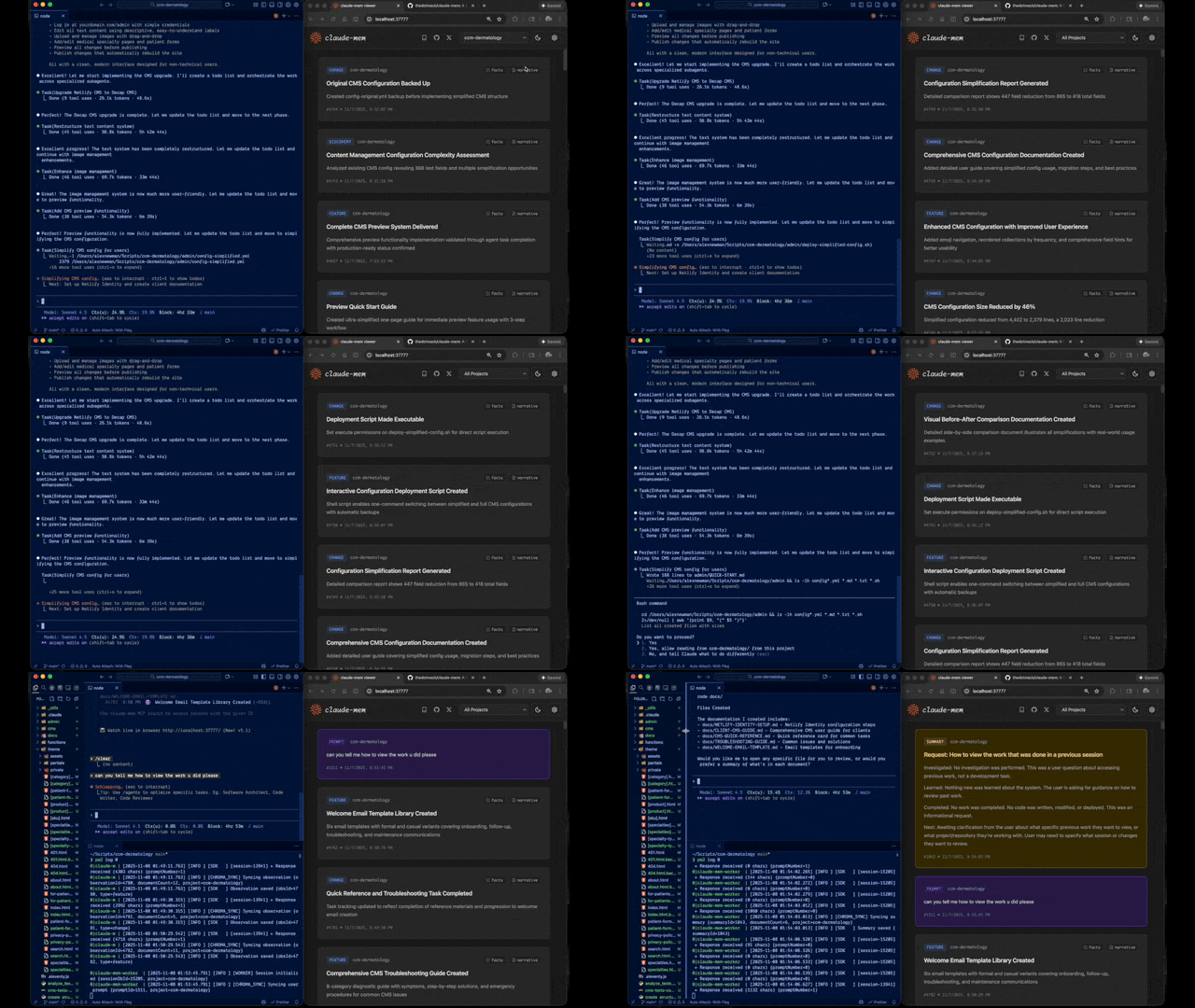
- 🖥️ Web Viewer UI - Real-time memory stream at http://localhost:37777
- 💻 Claude Desktop Skill - Search memory from Claude Desktop conversations
- 🔒 Privacy Control - Use
<private>tags to exclude sensitive content from storage - ⚙️ Context Configuration - Fine-grained control over what context gets injected
- 🤖 Automatic Operation - No manual intervention required
- 🔗 Citations - Reference past observations with IDs (access via http://localhost:37777/api/observation/{id} or view all in the web viewer at http://localhost:37777)
- 🧪 Beta Channel - Try experimental features like Endless Mode via version switching
Documentation
📚 View Full Documentation - Browse on official website
Getting Started
- Installation Guide - Quick start & advanced installation
- Usage Guide - How Claude-Mem works automatically
- Search Tools - Query your project history with natural language
- Beta Features - Try experimental features like Endless Mode
Best Practices
- Context Engineering - AI agent context optimization principles
- Progressive Disclosure - Philosophy behind Claude-Mem's context priming strategy
Architecture
- Overview - System components & data flow
- Architecture Evolution - The journey from v3 to v5
- Hooks Architecture - How Claude-Mem uses lifecycle hooks
- Hooks Reference - 7 hook scripts explained
- Worker Service - HTTP API & Bun management
- Database - SQLite schema & FTS5 search
- Search Architecture - Hybrid search with Chroma vector database
Configuration & Development
- Configuration - Environment variables & settings
- Development - Building, testing, contributing
- Troubleshooting - Common issues & solutions
How It Works
Core Components:
- 5 Lifecycle Hooks - SessionStart, UserPromptSubmit, PostToolUse, Stop, SessionEnd (6 hook scripts)
- Smart Install - Cached dependency checker (pre-hook script, not a lifecycle hook)
- Worker Service - HTTP API on port 37777 with web viewer UI and 10 search endpoints, managed by Bun
- SQLite Database - Stores sessions, observations, summaries
- mem-search Skill - Natural language queries with progressive disclosure
- Chroma Vector Database - Hybrid semantic + keyword search for intelligent context retrieval
See Architecture Overview for details.
MCP Search Tools
Claude-Mem provides intelligent memory search through 4 MCP tools following a token-efficient 3-layer workflow pattern:
The 3-Layer Workflow:
search- Get compact index with IDs (~50-100 tokens/result)timeline- Get chronological context around interesting resultsget_observations- Fetch full details ONLY for filtered IDs (~500-1,000 tokens/result)
How It Works:
- Claude uses MCP tools to search your memory
- Start with
searchto get an index of results - Use
timelineto see what was happening around specific observations - Use
get_observationsto fetch full details for relevant IDs - ~10x token savings by filtering before fetching details
Available MCP Tools:
search- Search memory index with full-text queries, filters by type/date/projecttimeline- Get chronological context around a specific observation or queryget_observations- Fetch full observation details by IDs (always batch multiple IDs)
Example Usage:
// Step 1: Search for index
search(query="authentication bug", type="bugfix", limit=10)

// Step 2: Review index, identify relevant IDs (e.g., #123, #456)

// Step 3: Fetch full details
get_observations(ids=[123, 456])
See Search Tools Guide for detailed examples.
Beta Features
Claude-Mem offers a beta channel with experimental features like Endless Mode (biomimetic memory architecture for extended sessions). Switch between stable and beta versions from the web viewer UI at http://localhost:37777 → Settings.
See Beta Features Documentation for details on Endless Mode and how to try it.
System Requirements
- Node.js: 18.0.0 or higher
- Claude Code: Latest version with plugin support
- Bun: JavaScript runtime and process manager (auto-installed if missing)
- uv: Python package manager for vector search (auto-installed if missing)
- SQLite 3: For persistent storage (bundled)
Windows Setup Notes
If you see an error like:
npm : The term 'npm' is not recognized as the name of a cmdlet
Make sure Node.js and npm are installed and added to your PATH. Download the latest Node.js installer from https://nodejs.org and restart your terminal after installation.
Configuration
Settings are managed in ~/.claude-mem/settings.json (auto-created with defaults on first run). Configure AI model, worker port, data directory, log level, and context injection settings.
See the Configuration Guide for all available settings and examples.
Development
See the Development Guide for build instructions, testing, and contribution workflow.
Troubleshooting
If experiencing issues, describe the problem to Claude and the troubleshoot skill will automatically diagnose and provide fixes.
See the Troubleshooting Guide for common issues and solutions.
Bug Reports
Create comprehensive bug reports with the automated generator:
cd ~/.claude/plugins/marketplaces/thedotmack
npm run bug-report
Contributing
Contributions are welcome! Please:
- Fork the repository
- Create a feature branch
- Make your changes with tests
- Update documentation
- Submit a Pull Request
See Development Guide for contribution workflow.
License
This project is licensed under the GNU Affero General Public License v3.0 (AGPL-3.0).
Copyright (C) 2025 Alex Newman (@thedotmack). All rights reserved.
See the LICENSE file for full details.
What This Means:
- You can use, modify, and distribute this software freely
- If you modify and deploy on a network server, you must make your source code available
- Derivative works must also be licensed under AGPL-3.0
- There is NO WARRANTY for this software
Note on Ragtime: The ragtime/ directory is licensed separately under the PolyForm Noncommercial License 1.0.0. See ragtime/LICENSE for details.
Support
- Documentation: docs/
- Issues: GitHub Issues
- Repository: github.com/thedotmack/claude-mem
- Official X Account: @Claude_Memory
- Official Discord: Join Discord
- Author: Alex Newman (@thedotmack)
Built with Claude Agent SDK | Powered by Claude Code | Made with TypeScript