 Alex Newman
e7bbb2a9aa
Alex Newman
e7bbb2a9aa
* feat(server-beta): Phase 4 — Postgres event-to-generation-job pipeline

Adds POST /v1/events, /v1/events/batch, GET /v1/jobs/:id, GET /v1/events/:id,
and POST /v1/memories on the server-beta runtime, backed by Postgres.

- Event row + outbox generation-job row insert in one withPostgresTransaction.
- BullMQ enqueue happens after commit; enqueue failure leaves the row queued
  for Phase 3 startup reconciliation.
- ?generate=false skips the outbox; ?wait=true returns queue status only,
  never observation IDs (provider generation is Phase 5).
- Batch pre-validates all event projectIds against api-key scope before any
  write; mixed-project batches reject 403 with zero side effects.
- /v1/memories is a direct insert alias — no generator, no outbox.
- Cross-tenant /v1/jobs/:id returns 404 to avoid leaking row existence.
- New PostgresAuthMiddleware reads api_keys by SHA-256 hash; populates
  req.authContext.teamId/projectId; legacy ServerV1Routes (SQLite, used by
  worker runtime) is left untouched.
- Tests: unit suite hardened with stubbed pool.query so route registration
  is safe; integration tests skip cleanly without CLAUDE_MEM_TEST_POSTGRES_URL.

Verification: 87 pass / 1 skip / 0 fail. No new typecheck errors. Required
greps for WorkerService and MemoryItemsRepository in src/server/routes/v1
and src/server/runtime return no hits.

Co-Authored-By: Claude Opus 4.7 (1M context) <noreply@anthropic.com>

* feat(server-beta): Phase 5 — provider observation generator

Adds independent provider generation under src/server/generation/ with no
worker coupling. Server beta can now generate observations end-to-end:
event -> outbox -> BullMQ -> provider -> parser -> persisted observation.

- ProviderObservationGenerator orchestrates: lock outbox (queued -> processing),
  reload agent_event from Postgres (BullMQ payload is advisory only), call
  provider, hand raw text to processGeneratedResponse, route errors via
  markGenerationFailed with retryable flag from ServerClassifiedProviderError.
- processGeneratedResponse parses with parseAgentXml, persists via
  PostgresObservationRepository with deterministic
  generation_key = generation:v1:{job_id}:{index}:{fingerprint},
  links via PostgresObservationSourcesRepository, advances outbox status,
  appends observation_generation_job_events, audits — all in one
  withPostgresTransaction. Idempotent on retry via UNIQUE constraints.
- Three provider adapters under src/server/generation/providers/:
  Claude, Gemini, OpenRouter. Self-contained — no imports from
  src/services/worker/*. Worker providers unchanged.
- Shared error classification + prompt builder under providers/shared/.
  Prompt builder strips <private> at the edge; fully-private batches
  emit <skip_summary /> without billing the provider.
- ActiveServerBetaGenerationWorkerManager wires BullMQ Worker via
  ServerJobQueue.start(...) with concurrency 1 + autorun:false +
  worker.on('error') per BullMQ docs.
- New GET /v1/events/:id/observations on ServerV1PostgresRoutes returns
  observations linked via observation_sources, team/project scoped.

Verification: 104 pass / 4 skip / 0 fail. No typecheck regressions.
Anti-pattern greps clean for services/worker imports under src/server,
WorkerRef/ActiveSession/SessionStore in src/server/generation.

Deferred: ModeManager loading uses a stable fallback observation type
list; summary and reindex queue lanes are not yet wired.

Co-Authored-By: Claude Opus 4.7 (1M context) <noreply@anthropic.com>

* feat(server-beta): Phase 6 — independent server session semantics

server_sessions is now the canonical Server beta session model. Sessions
are independent of legacy worker ActiveSession state.

- PostgresServerSessionRepository extended: findByExternalIdForScope,
  endSession (idempotent via COALESCE(ended_at, now())),
  markGenerationStarted/Completed/Failed, listUnprocessedEvents (filters
  agent_events with completed agent_event jobs).
- ServerSessionRuntimeRepository wraps the repo; every method requires
  explicit team_id + project_id and validates scope via assertProjectOwnership.
- SessionGenerationPolicy supports per-event (default), debounce
  (BullMQ delayed-job replace via getJob+remove+add), and end-of-session.
  Configured via CLAUDE_MEM_SERVER_SESSION_POLICY and
  CLAUDE_MEM_SERVER_SESSION_DEBOUNCE_MS env vars; per-team override hooks
  are exposed on ServerV1PostgresRoutesOptions for future settings layer.
- POST /v1/sessions/start (find-or-create on (project_id, external_session_id),
  GET /v1/sessions/:id (scoped 404), POST /v1/sessions/:id/end
  (transactional: end + create summary outbox via UNIQUE collapse +
  enqueue post-commit). Re-ending is fully idempotent.
- processSessionSummaryResponse persists summary as kind='summary'
  observation with the same idempotency model
  (generation_key + observation_sources UNIQUE).
- ProviderObservationGenerator dispatches on source_type:
  agent_event -> processGeneratedResponse, session_summary ->
  processSessionSummaryResponse; loadEvents handles session-summary
  by loading unprocessed events.
- ActiveServerBetaGenerationWorkerManager wires summary BullMQ lane
  alongside event lane (concurrency=1, autorun=false, error listener
  attached per BullMQ docs).

Verification: 110 pass / 6 skip / 0 fail. Net typecheck error count
unchanged at 24 (pre-existing, none in Phase 6 files). Anti-pattern
greps clean for ActiveSession/SessionStore in src/server/runtime,
no worker imports anywhere in src/server.

Co-Authored-By: Claude Opus 4.7 (1M context) <noreply@anthropic.com>

* feat(server-beta): Phase 7 — hook routing without worker dependency

Hooks can now talk directly to server-beta when CLAUDE_MEM_RUNTIME=server-beta
is selected, with a clean worker fallback when server-beta is unhealthy.

- src/services/hooks/server-beta-client.ts — typed HTTP client for
  /v1/sessions/start, /v1/events, /v1/sessions/:id/end. Throws
  ServerBetaClientError with kind classification (missing_api_key,
  transport, timeout, http_error, invalid_response) and isFallbackEligible
  helper. Zero imports from services/worker/.
- src/services/hooks/runtime-selector.ts — reads CLAUDE_MEM_RUNTIME from
  settings, returns worker or server-beta context, logs
  [server-beta-fallback] reason=<code> on every config-time fallback.
- src/services/hooks/server-beta-bootstrap.ts — Postgres-backed API key
  bootstrap. Find-or-creates local-hook-team + local-hook-project,
  generates cmem_<random> key (SHA-256 hashed), inserts into api_keys
  with scopes events:write/sessions:write/observations:read/jobs:read.
  Settings file written with chmod 0600. rotateServerBetaApiKey() wired
  to a new `claude-mem server keys rotate` command.
- src/cli/handlers/{observation,session-init,summarize}.ts — every hook
  handler tries server-beta first when configured, falls through to the
  existing worker path on transport/5xx/429/missing-key. One WARN line
  per fallback. Hook JSON output shape unchanged.
- src/shared/SettingsDefaultsManager.ts — three new keys with defaults:
  CLAUDE_MEM_SERVER_BETA_URL, CLAUDE_MEM_SERVER_BETA_API_KEY,
  CLAUDE_MEM_SERVER_BETA_PROJECT_ID.
- src/npx-cli/commands/install.ts — when installer selects server-beta
  runtime and CLAUDE_MEM_SERVER_DATABASE_URL is set, bootstraps a local
  API key automatically. Warns and continues if the DB URL is missing.

plugin/scripts/*.cjs bundles rebuilt via npm run build to pick up the
new hook handler code path. No plaintext keys in the bundle (verified).

Verification: 16 hook unit tests pass; 275 server/storage/services tests
pass with 7 pre-existing failures (verified independent of this change
via git stash --include-untracked). Build clean. No new typecheck
errors in Phase 7 files.

Anti-pattern guards verified:
- /api/sessions/observations only reached via explicit fallback path
- server-beta runtime never starts the worker process
- API keys live only in ~/.claude-mem/settings.json (chmod 0600), never
  in the bundle (grep confirmed)
- Worker fallback preserved, observable via single WARN line per call

Deferred: semantic context injection (UserPromptSubmit hook) stays
worker-only; server-beta does not yet expose /v1/context/semantic.

Co-Authored-By: Claude Opus 4.7 (1M context) <noreply@anthropic.com>

* feat(server-beta): Phase 8 — MCP backed by server-beta core

MCP tools now route through server-beta in server-beta mode while keeping
worker-mode search/timeline/get_observations tools fully working.

- src/servers/mcp-server.ts — five new observation_* tools registered:
  observation_add, observation_record_event, observation_search,
  observation_context, observation_generation_status. Three memory_*
  compatibility aliases delegate to the canonical handlers. Worker
  auto-start is gated when selectRuntime() === 'server-beta' so MCP
  in server-beta mode never spawns the worker.
- src/services/hooks/server-beta-client.ts — addObservation,
  searchObservations, contextObservations, getJobStatus added so MCP
  shares one transport with hooks (Phase 7).
- src/server/routes/v1/ServerV1PostgresRoutes.ts — POST /v1/search and
  POST /v1/context REST cores backed by PostgresObservationRepository
  full-text search (GIN tsvector from Phase 1).
- Existing memory_search/timeline/get_observations tools call
  callWorkerAPI unchanged in worker mode; worker tests unaffected.

Verification: 39 pass / 4 skip / 0 fail on targeted suite. Pre-existing
7 baseline failures verified independent (git stash). No new typecheck
errors. WorkerService grep clean across src/servers/mcp-server.ts and
src/server/.

Anti-pattern guards verified:
- No duplicate generation logic in MCP — observation_record_event hits
  /v1/events which owns event+outbox+enqueue inside one tx
- WorkerService not imported anywhere under MCP server-beta path
- No hardcoded worker URLs — all transport via Phase 7 ServerBetaClient
- memory_* aliases retained, single handler per pair

Co-Authored-By: Claude Opus 4.7 (1M context) <noreply@anthropic.com>

* feat(server-beta): Phase 9 — compatibility adapters without coupling

Legacy /api/sessions/observations and /api/sessions/summarize endpoints
keep working on server-beta runtime by translating to AgentEvent and
session-end calls — no worker code, no route duplication.

- src/server/services/IngestEventsService.ts — shared event-ingest path
  used by both /v1/events and the compat adapter. Owns transactional
  event row + outbox row + lifecycle log + post-commit BullMQ enqueue,
  honors Phase 6 SessionGenerationPolicy.
- src/server/services/EndSessionService.ts — shared session-end path
  used by both /v1/sessions/:id/end and the compat adapter. Idempotent
  ended_at + summary outbox + deterministic summary job id.
- src/server/compat/SessionsObservationsAdapter.ts — translates legacy
  POST /api/sessions/observations payload (Claude Code transcript shape)
  -> AgentEvent (source_adapter='claude-code-compat',
  event_type='tool_use') -> IngestEventsService.ingestOne. Resolves
  contentSessionId to server_sessions via find-or-create.
- src/server/compat/SessionsSummarizeAdapter.ts — translates legacy
  POST /api/sessions/summarize -> EndSessionService.end. Preserves the
  legacy agentId -> {status:'skipped', reason:'subagent_context'}
  behavior so existing clients see the same response shape.
- src/server/routes/v1/ServerV1PostgresRoutes.ts — refactored to
  delegate to the new shared services (-203 LoC net) so /v1 and
  /api compat both call the SAME canonical code path.
- src/server/runtime/ServerBetaService.ts — registers both compat
  adapters alongside ServerV1PostgresRoutes, sharing service instances.
- docs/server-beta-parity-map.md — full enumeration of legacy /api/*
  routes labeled native, adapter, or unsupported (with reasons).
  Viewer read-path adapters explicitly listed as unsupported pending
  a future viewer-rewrite phase.

Verification: 7 compat tests pass, 6 v1-routes tests still pass
(refactor preserved behavior), 4 session-routes tests pass. Pre-
existing 16 baseline failures verified independent via git stash.
Zero new typecheck errors.

Anti-pattern guards verified:
- No services/worker/http/routes or WorkerService imports under
  src/server/compat or src/server/runtime
- Compat adapters are thin translators with names ending in *Adapter
  and a top-of-file comment noting they are legacy compatibility
- /v1/* remains the canonical Server beta API; compat adapters
  call shared services rather than acting as a parallel API

Co-Authored-By: Claude Opus 4.7 (1M context) <noreply@anthropic.com>

* feat(server-beta): Phase 10 — Docker stack and deployable runtime

Server beta now ships as a Docker stack with no worker process anywhere
and a separate horizontal generation worker for scaling.

- src/server/runtime/create-server-beta-service.ts — validateServerBetaEnv()
  fails fast on missing CLAUDE_MEM_SERVER_DATABASE_URL, requires
  CLAUDE_MEM_QUEUE_ENGINE=bullmq in Docker, rejects
  CLAUDE_MEM_AUTH_MODE=local-dev and CLAUDE_MEM_ALLOW_LOCAL_DEV_BYPASS
  inside containers (detected via /.dockerenv or CLAUDE_MEM_DOCKER=1).
  Adds CLAUDE_MEM_GENERATION_DISABLED so the HTTP service can run
  generator-free.
- src/server/runtime/ServerBetaService.ts — runServerBetaGenerationWorker
  for the dedicated consumer process; runServerBetaApiKeyCli is a new
  Postgres-backed `server api-key` command (the legacy worker CLI wrote
  to SQLite and was invisible to the Postgres runtime); getQueueHealth
  shim feeds /api/health a consistent ObservationQueueHealth shape.
- src/npx-cli/commands/{runtime,server}.ts — `claude-mem server worker
  start` subcommand that boots only the BullMQ consumer.
- docker/claude-mem/{Dockerfile,entrypoint.sh} — entrypoint forces
  CLAUDE_MEM_DOCKER=1 + CLAUDE_MEM_RUNTIME=server-beta and exposes
  three modes: server (HTTP only, generation disabled), worker (BullMQ
  consumer), shell. Worker bundle is no longer the default CMD.
- docker-compose.yml — full stack: postgres + valkey + claude-mem-server
  (HTTP-only) + claude-mem-worker (generation consumer). Wires
  service-to-service env vars.
- scripts/e2e-server-beta-docker.sh + docker/e2e/server-beta-e2e.mjs —
  E2E now hits /v1/sessions/start, /v1/events?wait=true, /v1/jobs/:id;
  asserts no worker-service.cjs process anywhere in the stack;
  one-shot docker compose run --rm verifies local-dev auth is
  rejected with the expected stderr; restart-and-verify confirms
  Postgres durability and BullMQ retry idempotency.
- docs/server.md — full Phase 10 doc: stack diagram, env table,
  worker mode, auth-in-Docker policy.
- docs/api.md — event generation semantics (wait=true, generationJob).

Verification: full Docker E2E PASSED on live daemon
(phase1 + phase2 + restart-and-verify + revoked-key + no-worker-
process + local-dev-rejected). Unit tests 292 pass / 9 skip / 7 fail
(7 fails pre-existing baseline). Zero new typecheck errors.

Anti-pattern guards verified:
- entrypoint never execs worker-service.cjs; E2E greps prove no
  worker process anywhere in the stack
- validateServerBetaEnv refuses local-dev auth in Docker with explicit
  remediation message; ALLOW_LOCAL_DEV_BYPASS rejected the same way
- Docker requires CLAUDE_MEM_QUEUE_ENGINE=bullmq; in-process queue
  rejected at startup
- claude-mem worker / worker-service / WorkerService greps clean
  in docker/

Co-Authored-By: Claude Opus 4.7 (1M context) <noreply@anthropic.com>

* feat(server-beta): Phase 11 — team-aware generation with audit chain

Generation jobs now carry team_id/project_id/api_key_id/actor_id/
source_adapter from enqueue through execution; the outbox is reloaded
from Postgres before any side effect so BullMQ payload can never act
as auth authority.

- src/server/jobs/types.ts — ServerGenerationJobPayloadSchema (Zod
  discriminated union) requires team_id, project_id, generation_job_id,
  source_adapter, api_key_id, actor_id (nullable), source_type, source_id,
  plus event_id / server_session_id per kind. assertServerGenerationJobPayload
  is called at enqueue (outbox.ts) and again at execution boundary.
- src/server/services/{IngestEventsService,EndSessionService}.ts +
  SessionGenerationPolicy.ts — thread identity context (apiKeyId, actorId,
  sourceAdapter) into both event and summary BullMQ payloads.
- src/server/generation/ProviderObservationGenerator.ts —
  loadCanonicalOutbox loads the outbox row WITHOUT scope filter, then
  compares candidate.team_id/project_id to payload.team_id/project_id;
  mismatch -> ServerGenerationScopeViolationError (non-retryable),
  failed status, generation_job.scope_violation audit. isApiKeyRevoked
  checks api_keys (revoked_at, expires_at, row missing) before any
  provider call; revoked -> generation_job.revoked_key audit + non-
  retryable failure. generation_job.processing audit emitted on lock.
- src/server/generation/processGeneratedResponse.ts — generated
  observations carry team_id/project_id/server_session_id from the
  reloaded source row (not job payload). observation_sources.metadata
  records source_adapter, actor_id, api_key_id for traceability.
  observation.created audit per observation; generation_job.completed
  audit per terminal transition. All audit rows reference the same
  generation_job_id in details.
- src/server/routes/v1/ServerV1PostgresRoutes.ts — GET /v1/teams/:id/jobs
  and GET /v1/projects/:id/jobs with SQL-layer scoping (WHERE team_id=$1
  [AND project_id=$2] [AND status=$3]); cross-tenant returns 404 to
  avoid leaking row existence. Pagination via status/limit/offset.
  audit_log rows for event.received, event.batch_received, observation.read.
- src/server/compat/{SessionsObservationsAdapter,SessionsSummarizeAdapter}.ts —
  propagate apiKeyId and sourceAdapter='claude-code-compat'.

Verification: 162 pass / 10 skip / 0 fail. Pre-existing failures in
tests/services/queue and tests/services/worker confirmed independent
via git stash. Zero new typecheck errors in server-beta files.
Required greps:
  rg "team_id.*req\.body|project_id.*req\.body" src/server -> 0 matches
Audit chain integration test passes — generation_job.processing,
observation.created, and generation_job.completed audit rows all
share the same generation_job_id reference.

Anti-pattern guards verified:
- BullMQ payload never acts as auth authority — Postgres outbox
  reload with mismatch check happens before every side effect
- team_id / project_id never derived from request body for scope
  decisions; always req.authContext.teamId / projectId
- Application-layer team/project filtering forbidden — listJobsForScope
  pushes scope into the SQL WHERE clause
- Project-scoped key on cross-project /v1/teams/:id/jobs returns 404
- Revoked api keys cause non-retryable failure with audit before
  any provider call

Deferred: a redundant generation_job.queued audit_log row (already
covered by observation_generation_job_events lifecycle log per Phase 1
schema split). Compat adapters set actor_id=null but propagate
api_key_id which is the canonical reference downstream.

Co-Authored-By: Claude Opus 4.7 (1M context) <noreply@anthropic.com>

* feat(server-beta): Phase 12 — observability and operations

Operators can now inspect, retry, and cancel generation jobs from the
CLI; queue lane metrics flow into /api/health and /v1/info; every
request gets a stable request_id that flows through HTTP -> audit ->
outbox -> generator -> completion log.

- src/server/middleware/request-id.ts — honors safe inbound X-Request-Id,
  mints uuid v4 otherwise. Set on req.requestId and echoed via response
  header so external traces can correlate.
- src/server/jobs/ServerJobQueue.ts — QueueEvents wired with completed,
  failed, progress, stalled, error listeners; lifecycle counters
  exposed via observe() API. Logs emitted as
  [generation] job=<id> source_type=<...> duration=<ms> attempts=<N>
  reason=<message>. Stalled and error counters survive worker restart.
- src/server/jobs/types.ts — ServerGenerationJob payload schema
  extended with optional request_id; flows through from HTTP into
  every BullMQ job.
- src/server/queue/ObservationQueueEngine.ts — health snapshot now
  carries per-lane (event, summary) counts via
  ObservationQueueHealthLaneSnapshot.
- src/server/runtime/{ActiveServerBetaQueueManager,
  ActiveServerBetaGenerationWorkerManager,ServerBetaService}.ts —
  per-lane getJobCounts feed /api/health and /v1/info; stalled events
  audit through audit_log with action generation_job.stalled.
- src/server/routes/v1/ServerV1PostgresRoutes.ts —
  GET /v1/jobs (status/source_type/since/limit/offset, scope from
  api-key, payload stripped unless ?include=payload AND admin scope),
  POST /v1/jobs/:id/retry (idempotent; queued -> no-op; audit
  generation_job.retried_by_operator), POST /v1/jobs/:id/cancel
  (terminal -> no-op; audit generation_job.cancelled_by_operator;
  generator reload-before-side-effects already prevents double work).
- src/server/services/IngestEventsService.ts +
  SessionGenerationPolicy.ts + ProviderObservationGenerator.ts —
  request_id propagated end to end. Generator extracts request_id
  from BullMQ payload and includes it in lock/processing/completion
  logs and audit details.
- src/npx-cli/commands/server-jobs.ts +
  src/npx-cli/commands/server.ts — `claude-mem server jobs
  status|failed|retry|cancel`. status compares Postgres outbox counts
  to BullMQ queue counts and surfaces divergence. failed prints
  attempts + last_error message. --team and --project filters.

Verification: 350 pass / 12 skip / 7 fail (pre-existing baseline,
verified independent via git stash). 18 new tests added (request-id
middleware, server-jobs CLI seams, jobs list/retry/cancel routes
Postgres-gated). Zero new typecheck errors.

Anti-pattern guards verified:
- agent_events.payload only emitted in /v1/jobs response inside the
  admin-gated branch (?include=payload + admin scope) — returns 403
  otherwise
- jobs retry on a queued row is a no-op (no double BullMQ enqueue,
  no double UPDATE)
- Every operator action writes to audit_log with the
  *_by_operator action and request_id correlation in details
- Stalled events audit through generation_job.stalled

Sample correlated trace (one request_id end to end):
  HTTP middleware: req.requestId = 'req-abc'
  audit event.received: details.requestId = 'req-abc'
  BullMQ payload: { request_id: 'req-abc', generation_job_id: 'gj_x' }
  generator lock log: [generation] job locked { jobId, requestId }
  audit generation_job.processing: details.requestId = 'req-abc'
  completion log: [generation] job=evt_... duration=1230ms

Deferred: live /api/health round-trip integration test (needs
Redis); stalled event live integration test (needs Redis); storing
request_id on the observations row itself (spec did not require).

Co-Authored-By: Claude Opus 4.7 (1M context) <noreply@anthropic.com>

* docs(server-beta): add Phase 13 release readiness report

Captures the final verification gate: tests (1749 pass, 45 fail all
pre-existing baseline, zero regressions), required greps clean,
Docker E2E green end-to-end, all 7 exit criteria met, build clean,
typecheck unchanged from main. Documents deferred items.

Co-Authored-By: Claude Opus 4.7 (1M context) <noreply@anthropic.com>

* build(server-beta): rebuild server-beta-service bundle

Co-Authored-By: Claude Opus 4.7 (1M context) <noreply@anthropic.com>

* fix(server-beta): address Greptile review on PR #2383

- ProviderObservationGenerator.lockOutbox: skip duplicate worker run when
  another lock is active instead of returning the row, which previously let
  two BullMQ workers issue the (paid, rate-limited) external provider call
  before the persistence-layer terminal-status guard collapsed the duplicate.
  Reconciliation still recovers from a stale lock on startup or next retry.
- docker-compose.yml: require POSTGRES_USER/PASSWORD/DB env vars (no
  defaults). Stack refuses to start without explicit secrets. Added a header
  warning that the file must not be deployed unmodified.
- e2e-server-beta-docker.sh: export ephemeral test creds for the new
  required env vars so the Docker E2E driver still runs unattended.
- ServerBetaService api-key list: bound query with LIMIT/OFFSET (default 100,
  max 500) and add optional --team filter to prevent unintentional
  cross-tenant key metadata disclosure on shared admin hosts.
- SessionGenerationPolicy: fix dead `??` fallback for NaN parseInt result;
  use `||` so DEFAULT_DEBOUNCE_MS actually applies.
- ServerV1PostgresRoutes: `?wait=true` now actually waits — polls the outbox
  row until terminal status (timeout 30s, 100ms interval) on both
  /v1/events and /v1/events/batch. Returns `waitTimedOut: true` if the cap
  is hit so callers can re-poll the status endpoints.

Co-Authored-By: Claude Opus 4.7 (1M context) <noreply@anthropic.com>

* fix(server-beta): address CodeRabbit + Greptile second review on PR #2383

P1 fixes
- Operator retry endpoint was re-publishing the Postgres outbox metadata
  column as the BullMQ payload; the worker's
  assertServerGenerationJobPayload always rejected it, leaving the row
  stuck in queued until startup reconciliation. Persist the BullMQ payload
  on the outbox row at create-time inside IngestEventsService and
  EndSessionService, then re-enqueue that canonical payload on retry.

Major fixes
- prompt-builder: escape server_session_id when interpolating into the
  XML prompt; previously a session id containing `<`, `&`, or quotes
  could inject XML into the provider input.
- ServerJobQueue: route both worker.on('stalled') and the QueueEvents
  'stalled' subscriber through a single notifyStalled helper that
  dedupes by jobId for 30s, so counters.stalled increments once per
  stall. QueueEvents 'error' now routes through notifyQueueError so
  it increments counters.errored and runs onError listeners — keeping
  observability symmetric across both sources.
- ServerV1PostgresRoutes: convert PostgresObservationRepository from
  three dynamic imports to a single static import for consistency.
- mcp-server / ServerBetaClient: actually forward the
  observation_record_event tool's `generate` flag through to the
  /v1/events endpoint as `?generate=false` instead of voiding it.
- server-sessions.markGenerationFailed: guard jsonb_set against a null
  error payload so the failure path can't null out metadata before the
  generation_status='failed' write commits.

Minor fixes
- server-sessions.endSession: keep updated_at stable on repeated calls
  so the documented idempotency contract holds.
- SettingsDefaultsManager + ServerBetaService.getServerBetaPort: derive
  the server-beta default port from UID (37877 + uid%100), matching the
  worker port pattern, so two users on the same host don't collide.
  Docker stacks always pass CLAUDE_MEM_SERVER_PORT explicitly so the
  containerized deployment is unaffected.
- server-session-runtime test: close the pg.Pool in afterAll.
- server-beta-release-readiness.md: escape pipes inside table inline
  code, add `text` language tag to the fenced log block.

Co-Authored-By: Claude Opus 4.7 (1M context) <noreply@anthropic.com>

* fix(server-beta): address Greptile + CodeRabbit third review on PR #2383

P1 fixes
- SessionsObservationsAdapter.resolveServerSession: catch unique-violation
  (23505) on concurrent compat inserts and re-fetch instead of returning
  500. Two compat callers carrying the same contentSessionId can both
  observe `existing===null` and race on the (project_id,
  external_session_id) unique constraint; the second now resolves to the
  raced row instead of dropping the event.
- /v1/events/batch: pass `sourceAdapter: null` to ingestBatch so each
  event's BullMQ payload (and persisted outbox payload column) reflects
  its own event.sourceAdapter via buildEventBullmqPayload's fallback,
  rather than stamping the whole batch with the first event's adapter.

Minor
- server-session-runtime test afterEach: wrap DROP SCHEMA in try/finally
  so client.release() always runs even if the drop throws.

Co-Authored-By: Claude Opus 4.7 (1M context) <noreply@anthropic.com>

* fix(test): drop `pool as never` cast — pg.Pool already matches PostgresPool

Co-Authored-By: Claude Opus 4.7 (1M context) <noreply@anthropic.com>

* fix(server-beta): retry of completed job now 409s instead of duplicating

retryGenerationJob previously fell through to the reset+re-enqueue path
when called on a job in `completed` status. The observations index
dedupes on (generation_job_id, parsed_observation_index, content) but
LLM output is non-deterministic, so a second provider run almost always
produced a different content string and bypassed the index, persisting a
parallel set of observation rows attributed to the same generation job.

Match cancelGenerationJob's 409 guard for completed jobs. failed and
cancelled remain valid retry targets.

Co-Authored-By: Claude Opus 4.7 (1M context) <noreply@anthropic.com>

* build(server-beta): rebuild bundles after rebase onto main

Regenerates the three plugin bundles so they reflect the rebased source
state. Mechanical rebuild output only — no source changes.

Co-Authored-By: Claude Opus 4.7 (1M context) <noreply@anthropic.com>

* fix(server-beta): wrap resolveServerSession in try/catch for structured error response

Greptile P1 on PR #2383: resolveServerSession was called before the try/catch
in both compat adapters, so Postgres errors during session lookup (timeout,
pool exhaustion, etc.) escaped to Express's default error handler and returned
HTML/text 500s. Legacy clients calling response.json() would get a parse
failure instead of the documented { stored: false, reason: 'internal_error' }
(or { status: 'error', reason: 'internal_error' } for the summarize adapter)
shape.

Move the resolveServerSession call inside the existing try block in both
adapters so any failure flows through the structured catch handler.

Co-Authored-By: Claude Opus 4.7 (1M context) <noreply@anthropic.com>

* fix(server-beta): catch 23505 unique violation in POST /v1/sessions/start

Greptile P1 on PR #2383: concurrent requests with the same externalSessionId
can both pass the findByExternalIdForScope check, both call repo.create,
and the loser hits the (project_id, external_session_id) unique constraint.
The handler treated that as an unknown error and returned a 500.

Apply the same pattern resolveServerSession already uses: catch error.code
'23505' when externalSessionId is set, refetch the row inserted by the
winning request, and return 200 with that session.

Co-Authored-By: Claude Opus 4.7 (1M context) <noreply@anthropic.com>

---------

Co-authored-by: Claude Opus 4.7 (1M context) <noreply@anthropic.com>


🇨🇳 中文 • 🇹🇼 繁體中文 • 🇯🇵 日本語 • 🇵🇹 Português • 🇧🇷 Português • 🇰🇷 한국어 • 🇪🇸 Español • 🇩🇪 Deutsch • 🇫🇷 Français • 🇮🇱 עברית • 🇸🇦 العربية • 🇷🇺 Русский • 🇵🇱 Polski • 🇨🇿 Čeština • 🇳🇱 Nederlands • 🇹🇷 Türkçe • 🇺🇦 Українська • 🇻🇳 Tiếng Việt • 🇵🇭 Tagalog • 🇮🇩 Indonesia • 🇹🇭 ไทย • 🇮🇳 हिन्दी • 🇧🇩 বাংলা • 🇵🇰 اردو • 🇷🇴 Română • 🇸🇪 Svenska • 🇮🇹 Italiano • 🇬🇷 Ελληνικά • 🇭🇺 Magyar • 🇫🇮 Suomi • 🇩🇰 Dansk • 🇳🇴 Norsk
Persistent memory compression system built for Claude Code.





|
|
Quick Start • How It Works • Search Tools • Documentation • Configuration • Troubleshooting • License
Claude-Mem seamlessly preserves context across sessions by automatically capturing tool usage observations, generating semantic summaries, and making them available to future sessions. This enables Claude to maintain continuity of knowledge about projects even after sessions end or reconnect.
Quick Start
Install with a single command:
npx claude-mem install
Or install for Gemini CLI (auto-detects ~/.gemini):
npx claude-mem install --ide gemini-cli
Or install for OpenCode:
npx claude-mem install --ide opencode
Or install from the plugin marketplace inside Claude Code:
/plugin marketplace add thedotmack/claude-mem

/plugin install claude-mem
Restart Claude Code or Gemini CLI. Context from previous sessions will automatically appear in new sessions.
Note: Claude-Mem is also published on npm, but
npm install -g claude-meminstalls the SDK/library only — it does not register the plugin hooks or set up the worker service. Always install vianpx claude-mem installor the/plugincommands above.
🦞 OpenClaw Gateway
Install claude-mem as a persistent memory plugin on OpenClaw gateways with a single command:
curl -fsSL https://install.cmem.ai/openclaw.sh | bash
The installer handles dependencies, plugin setup, AI provider configuration, worker startup, and optional real-time observation feeds to Telegram, Discord, Slack, and more. See the OpenClaw Integration Guide for details.
Key Features:
- 🧠 Persistent Memory - Context survives across sessions
- 📊 Progressive Disclosure - Layered memory retrieval with token cost visibility
- 🔍 Skill-Based Search - Query your project history with mem-search skill
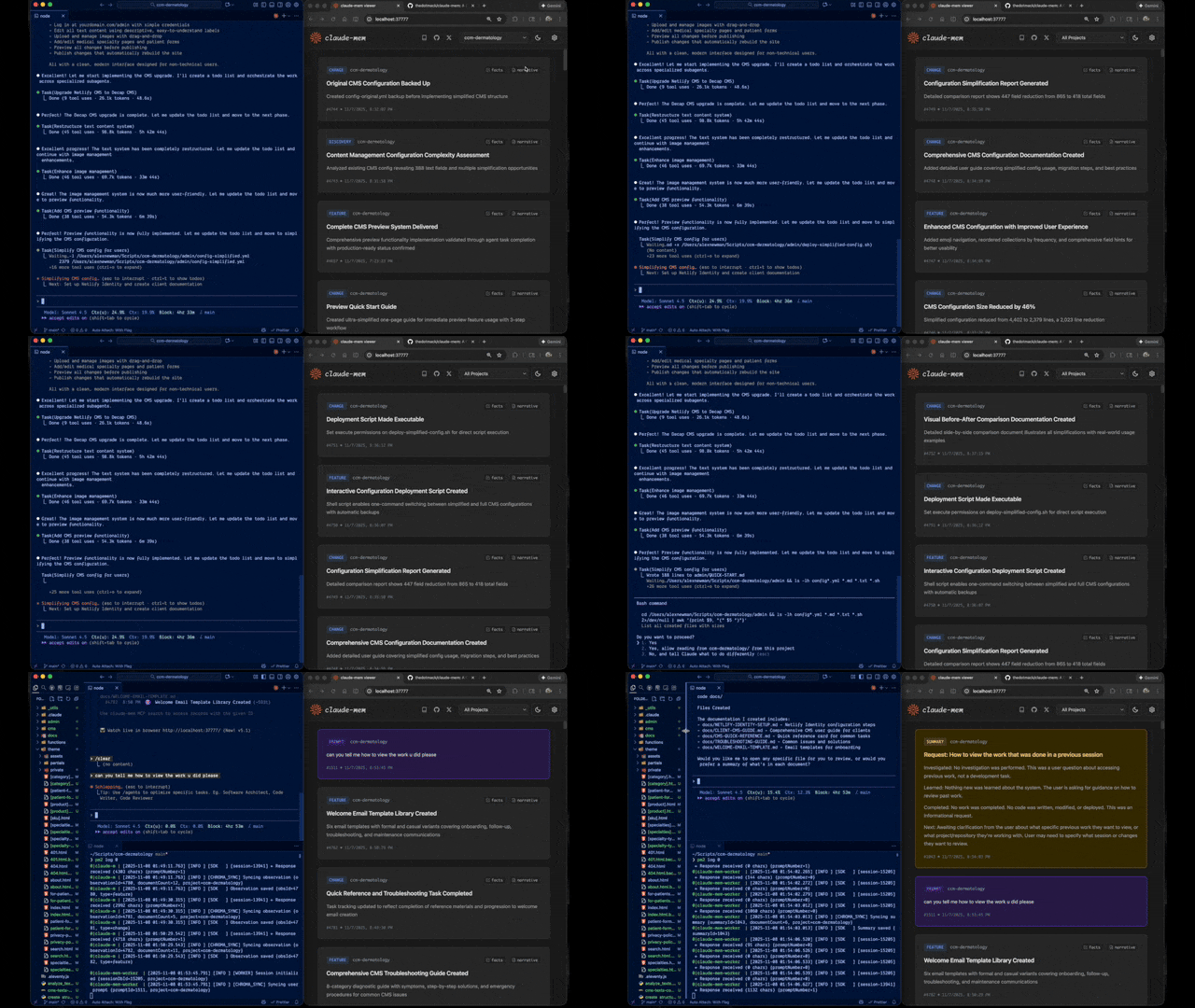
- 🖥️ Web Viewer UI - Real-time memory stream at http://localhost:37777
- 💻 Claude Desktop Skill - Search memory from Claude Desktop conversations
- 🔒 Privacy Control - Use
<private>tags to exclude sensitive content from storage - ⚙️ Context Configuration - Fine-grained control over what context gets injected
- 🤖 Automatic Operation - No manual intervention required
- 🔗 Citations - Reference past observations with IDs (access via http://localhost:37777/api/observation/{id} or view all in the web viewer at http://localhost:37777)
- 🧪 Beta Channel - Try experimental features like Endless Mode via version switching
Documentation
📚 View Full Documentation - Browse on official website
Getting Started
- Installation Guide - Quick start & advanced installation
- Gemini CLI Setup - Dedicated guide for Google's Gemini CLI integration
- Usage Guide - How Claude-Mem works automatically
- Search Tools - Query your project history with natural language
- Beta Features - Try experimental features like Endless Mode
Best Practices
- Context Engineering - AI agent context optimization principles
- Progressive Disclosure - Philosophy behind Claude-Mem's context priming strategy
Architecture
- Overview - System components & data flow
- Architecture Evolution - The journey from v3 to v5
- Hooks Architecture - How Claude-Mem uses lifecycle hooks
- Hooks Reference - 7 hook scripts explained
- Worker Service - HTTP API & Bun management
- Database - SQLite schema & FTS5 search
- Search Architecture - Hybrid search with Chroma vector database
Configuration & Development
- Configuration - Environment variables & settings
- Development - Building, testing, contributing
- Troubleshooting - Common issues & solutions
How It Works
Core Components:
- 5 Lifecycle Hooks - SessionStart, UserPromptSubmit, PostToolUse, Stop, SessionEnd (6 hook scripts)
- Smart Install - Cached dependency checker (pre-hook script, not a lifecycle hook)
- Worker Service - HTTP API on port 37777 with web viewer UI and 10 search endpoints, managed by Bun
- SQLite Database - Stores sessions, observations, summaries
- mem-search Skill - Natural language queries with progressive disclosure
- Chroma Vector Database - Hybrid semantic + keyword search for intelligent context retrieval
See Architecture Overview for details.
MCP Search Tools
Claude-Mem provides intelligent memory search through 4 MCP tools following a token-efficient 3-layer workflow pattern:
The 3-Layer Workflow:
search- Get compact index with IDs (~50-100 tokens/result)timeline- Get chronological context around interesting resultsget_observations- Fetch full details ONLY for filtered IDs (~500-1,000 tokens/result)
How It Works:
- Claude uses MCP tools to search your memory
- Start with
searchto get an index of results - Use
timelineto see what was happening around specific observations - Use
get_observationsto fetch full details for relevant IDs - ~10x token savings by filtering before fetching details
Available MCP Tools:
search- Search memory index with full-text queries, filters by type/date/projecttimeline- Get chronological context around a specific observation or queryget_observations- Fetch full observation details by IDs (always batch multiple IDs)
Example Usage:
// Step 1: Search for index
search(query="authentication bug", type="bugfix", limit=10)

// Step 2: Review index, identify relevant IDs (e.g., #123, #456)

// Step 3: Fetch full details
get_observations(ids=[123, 456])
See Search Tools Guide for detailed examples.
Beta Features
Claude-Mem offers a beta channel with experimental features like Endless Mode (biomimetic memory architecture for extended sessions). Switch between stable and beta versions from the web viewer UI at http://localhost:37777 → Settings.
See Beta Features Documentation for details on Endless Mode and how to try it.
System Requirements
- Node.js: 18.0.0 or higher
- Claude Code: Latest version with plugin support
- Bun: JavaScript runtime and process manager (auto-installed if missing)
- uv: Python package manager for vector search (auto-installed if missing)
- SQLite 3: For persistent storage (bundled)
Windows Setup Notes
If you see an error like:
npm : The term 'npm' is not recognized as the name of a cmdlet
Make sure Node.js and npm are installed and added to your PATH. Download the latest Node.js installer from https://nodejs.org and restart your terminal after installation.
Configuration
Settings are managed in ~/.claude-mem/settings.json (auto-created with defaults on first run). Configure AI model, worker port, data directory, log level, and context injection settings.
See the Configuration Guide for all available settings and examples.
Mode & Language Configuration
Claude-Mem supports multiple workflow modes and languages via the CLAUDE_MEM_MODE setting.
This option controls both:
- The workflow behavior (e.g. code, chill, investigation)
- The language used in generated observations
How to Configure
Edit your settings file at ~/.claude-mem/settings.json:
{
  "CLAUDE_MEM_MODE": "code--zh"
}
Modes are defined in plugin/modes/. To see all available modes locally:
ls ~/.claude/plugins/marketplaces/thedotmack/plugin/modes/
Available Modes
| Mode | Description |
|---|---|
code |
Default English mode |
code--zh |
Simplified Chinese mode |
code--ja |
Japanese mode |
Language-specific modes follow the pattern code--[lang] where [lang] is the ISO 639-1 language code (e.g., zh for Chinese, ja for Japanese, es for Spanish).
Note:
code--zh(Simplified Chinese) is already built-in — no additional installation or plugin update is required.
After Changing Mode
Restart Claude Code to apply the new mode configuration.
Development
See the Development Guide for build instructions, testing, and contribution workflow.
Troubleshooting
If experiencing issues, describe the problem to Claude and the troubleshoot skill will automatically diagnose and provide fixes.
See the Troubleshooting Guide for common issues and solutions.
Bug Reports
Create comprehensive bug reports with the automated generator:
cd ~/.claude/plugins/marketplaces/thedotmack
npm run bug-report
Contributing
Contributions are welcome! Please:
- Fork the repository
- Create a feature branch
- Make your changes with tests
- Update documentation
- Submit a Pull Request
See Development Guide for contribution workflow.
License
Claude-Mem is licensed under the Apache License 2.0.
We chose Apache-2.0 because durable agentic memory should be easy to embed in developer tools, local agents, MCP servers, enterprise systems, robotics stacks, and production agent harnesses.
See the LICENSE file for full details. See docs/license.md and docs/ip-boundary.md for licensing scope and the open/commercial boundary.
Note on Ragtime: The ragtime/ directory is licensed under the Apache License 2.0. See ragtime/LICENSE for details.
Support
- Documentation: docs/
- Issues: GitHub Issues
- Repository: github.com/thedotmack/claude-mem
- Official X Account: @Claude_Memory
- Official Discord: Join Discord
- Author: Alex Newman (@thedotmack)
Built with Claude Agent SDK | Works with Claude Code | Made with TypeScript
What About $CMEM?
$CMEM is a solana token created by a 3rd party without Claude-Mem's prior consent, but officially embraced by the creator of Claude-Mem (Alex Newman, @thedotmack). The token acts as a community catalyst for growth and a vehicle for bringing real-time agent data to the developers and knowledge workers that need it most. $CMEM: 2TsmuYUrsctE57VLckZBYEEzdokUF8j8e1GavekWBAGS